




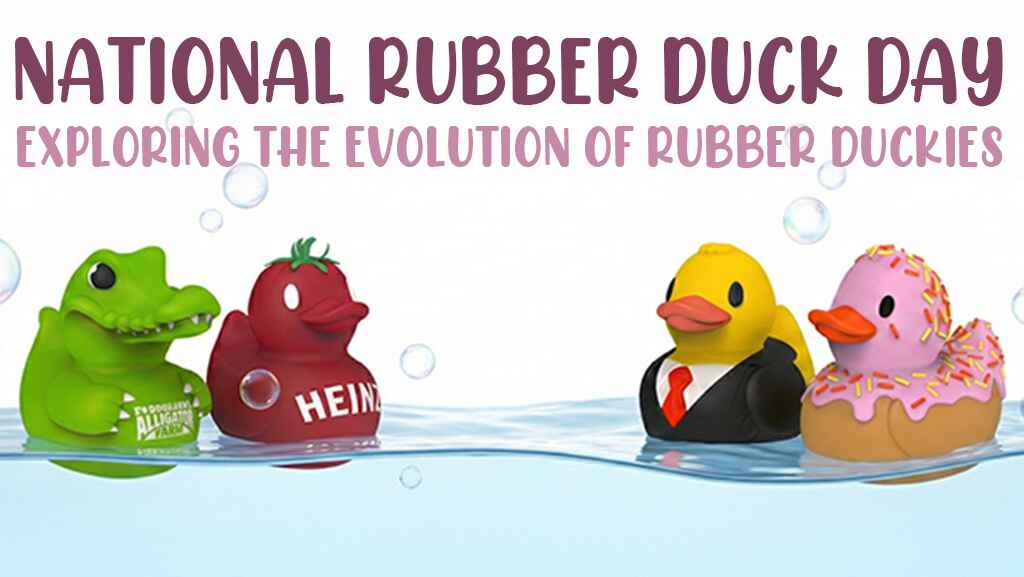
National Rubber Duck Day: Exploring the Evolution of Rubber Duckies
Rubber Ducks, From the Bathtub to the Boardroom
The rubber duck is a simple object with a long history. They've been around for well over a century, but their place in popular culture was firmly cemented in 1970, when "Rubber Duckie from Sesame Street reached number 16 on the Billboard Hot 100. It's a rare achievement for a children's song, and an even rarer one for a bath toy. Fast forward to today, and over a billion rubber ducks are produced every year!
That brief run on the charts helped turn a simple duck into a widely recognized cultural reference, one that has endured far longer than most novelty items. Since then, rubber ducks have remained a quiet part of everyday life. They're in bathtubs, on office desks, and on Jeep dashboards. National Rubber Duck Day takes place on January 13 (the birthday of Ernie's Rubber Duckie on Sesame Street) it's worth taking a look at where rubber ducks came from, their evolution over time, and why they remain popular today!
The Evolution of the Rubber Duck
Early rubber ducks appeared in the late 19th and early 20th centuries, shortly after rubber became practical for consumer toys. These early versions were very different from the floating bath toys we would think of. They were solid, heavy, and firm, designed for durability rather than buoyancy, and most did not float at all. The rubber duck associated with the modern bath toy design is generally credited to Peter Ganine, who patented a floating duck in 1949. This version was lighter and air-filled, making it better suited for bathtime use.
By the early 21st century, rubber ducks had another major change. Most were no longer made from natural rubber, but from vinyl plastic instead. This shift improved durability and consistency, while allowing manufacturers to produce ducks at larger scales without altering their recognizable shape.
The duck's growing visibility was then reinforced by popular culture. When Sesame Street's "Rubber Duckie" reached number 16 on the Billboard Hot 100, it cemented the rubber duck as a familiar symbol of childhood, one that has remained recognizable ever since.
Beyond the Bathtub
As rubber ducks became more familiar, they also moved into the art world. In 2007, Dutch artist Florentijn Hofman introduced a giant inflatable rubber duck, titled "Rubber Duck". Standing roughly 65 feet tall, the massive duck appeared in harbors and waterways around the world, drawing crowds simply by taking a small, familiar object and making it impossibly large. The installations are very popular, and continue to this day! In fact, Mama Duck (an homage to Hofman's Rubber Duck), had an installation in Clearwater, Florida just the other day!
Rubber ducks have also found a place in professional settings. In software development, "rubber duck debugging" refers to the practice of explaining code out loud to an inanimate object, often a rubber duck, to help identify mistakes or logic gaps. The technique is common enough that rubber ducks frequently sit on developers' desks as informal problem-solving tools.
Rubber ducks have even contributed to scientific understanding. When thousands of rubber ducks were accidentally spilled into the ocean in the 1990s, their slow drift over several years became a real-world example of how ocean currents move debris across vast distances.
And we can't forget the Jeeps! Rubber ducks have become part of modern car culture through a tradition known as Jeep ducking, or Duck, Duck, Jeep. Jeep owners leave rubber ducks on other vehicles as a friendly, anonymous gesture. The practice shows how rubber ducks can be simple symbols of friendliness and goodwill, even among adults.
Custom Shape Rubber Duckies at Logotech
There's a reason for the long-term staying power of rubber duckies; they're familiar, playful, and instantly recognizable. That combination makes them a natural fit for promotional use!

At Logotech, we can create custom-shaped rubber duckies, allowing brands to put their own stamp on the design. Our custom rubber duckies can be created in fully custom shapes, fitted with accessories, or designed with features modeled after your brand's mascot or theme. Custom rubber duckies are awesome for trade shows, seasonal promotions, community events, and internal brand initiatives. In those settings, a small, well-designed item that people are inclined to keep can have a greater effect than something purely practical.
The Staying Power of the Rubber Duck
Rubber ducks have lasted because they're easy to recognize and hard to overthink. Their shape hasn't needed constant reinvention, even as their materials, uses, and cultural roles have changed. That consistency is what allows them to feel familiar in new settings, whether they're floating in a bathtub, sitting on a desk, or scaled up to impossible size.
That same familiarity makes custom rubber duckies an unusually flexible promotional product. When the design can be pushed in any direction, from mascots and accessories to fully reimagined characters, brands aren't limited by format. When a rubber duck can be shaped into almost anything, it's easy to see why it has never really gone out of style!
Learn more about rubber duckies with Logotech's Professor Brandwell: