



USB Flash Drive History: From 8MB to 4TB | by Logotech
How a Pocket-Sized Device Changed the Way the World Stores and Shares Data
The USB flash drive is one of those inventions that's easy to take for granted. It sits on a keychain, fits in a pocket, and holds more data than a roomful of floppy disks. But for something so familiar, its origins are surprisingly contested - and its evolution over the past 25 years is a story worth knowing.
Before the flash drive existed, moving files between computers meant carrying floppy disks that held less than 1.5MB, burning CDs that required planning and patience, or emailing yourself attachments and hoping the file size didn't get rejected. The need for something better was obvious. What wasn't obvious was who would solve the problem first - or how quickly the solution would reshape everyday computing.
This article covers the full history of the USB flash drive: where it came from, who invented it (a question with a genuinely complicated answer), how the technology evolved through multiple USB standards, and where it stands today.
Before the Flash Drive: Life with Floppy Disks and Optical Media
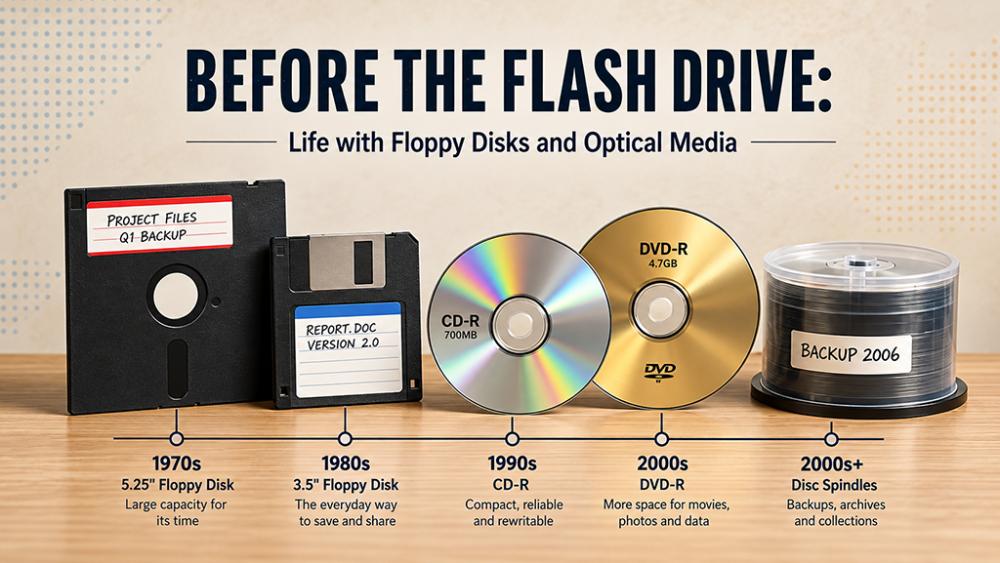
To understand why the USB flash drive mattered, it helps to remember what came before it. The 3.5-inch floppy disk was the dominant portable storage format through the 1990s. It was reliable enough, but capped at 1.44MB - barely enough for a Word document, let alone anything larger. Optical drives like CDs extended that capacity to around 700MB, but writing to them required separate hardware and wasn't rewritable in any practical sense for most users.
Portable data storage was a real friction point. The files people needed to move were getting bigger. The tools available to move them weren't keeping pace. That gap is what made the flash drive's arrival in 2000 feel, to many people, like an immediate and obvious upgrade.
Who Invented the USB Flash Drive? A Contested History
The invention of the USB flash drive doesn't belong cleanly to one person or company - and that ambiguity has led to decades of patent disputes.
The most widely recognized origin story starts with M-Systems, an Israeli company led by engineer Dov Moran. On April 5, 1999, Moran and colleagues Amir Ban and Oron Ogdan filed a patent for a device they called the "DiskOnKey" - a combination of NAND flash memory, a USB controller, and a USB connector in a single compact unit. The patent was granted in November 2000, and the DiskOnKey launched commercially around the same time, initially sold through IBM with 8MB of storage capacity.
Moran has spoken publicly about the moment that motivated the invention: he arrived at a presentation and had no way to transfer his files to the available computer. That experience, he later recalled, convinced him he would never again show up without a backup in his pocket.
But M-Systems wasn't the only claimant. Trek 2000 International, a Singapore-based company, was the first to publicly sell a USB flash drive - trademarked as the "ThumbDrive" - at a trade fair in Germany in early 2000. Trek 2000 later won a Singapore court ruling in its favor and maintained that it was the original inventor of the device. IBM engineer Shimon Shmueli also filed an invention disclosure with the U.S. Patent and Trademark Office in 1999, asserting his own claim. Netac Technology in China filed a separate patent application the same year. Taiwan-based Phison Electronics, led by CEO Pua Khein-Seng, made similar claims.
The result was years of litigation. Netac's U.S. patent was eventually granted in 2004, and in the subsequent lawsuit PNY paid $7.71 million in royalties to Netac - a 12-year legal battle confirmed by a New Jersey federal court in 2019. M-Systems was acquired by SanDisk in 2006 for $1.55 billion. Trek 2000's UK patent was revoked in 2005, even after winning in Singapore. A full overview of the competing claims and patent disputes is documented in Britannica's entry on the USB flash drive.
The honest answer to "who invented the USB flash drive" is: several teams, independently, at roughly the same time. What made it a product was the convergence of flash memory, the Universal Serial Bus standard, and manufacturers willing to bring it to market.
The Technology Behind It: USB and Flash Memory
The USB flash drive was only possible because two technologies matured at the right moment.
Flash memory - specifically NAND flash - was developed by Fujio Masuoka at Toshiba in the early 1980s. It allowed data to be stored and rewritten without requiring power to retain it, making it ideal for portable use. Unlike earlier storage types, flash memory had no moving parts, which made it far more durable than magnetic disk formats.
The Universal Serial Bus (USB) standard was developed starting in 1994, co-led by Ajay Bhatt of Intel and the USB Implementers Forum - a consortium that included Intel, Microsoft, Apple, Compaq, and Hewlett-Packard. USB 1.0 arrived in 1996, standardizing how devices connected to computers and replacing the tangle of serial and parallel ports that had defined PC connectivity until then. USB 2.0 followed in 2000, raising the theoretical maximum data transfer speed to 480 Mbps - roughly 40 times faster than its predecessor.
The flash drive combined both: flash storage for non-volatile, portable memory, and the USB connection for instant plug-and-play access without drivers or external power. That combination, more than either technology alone, is what made it work.
How USB Flash Drives Evolved: From 8MB to 4TB
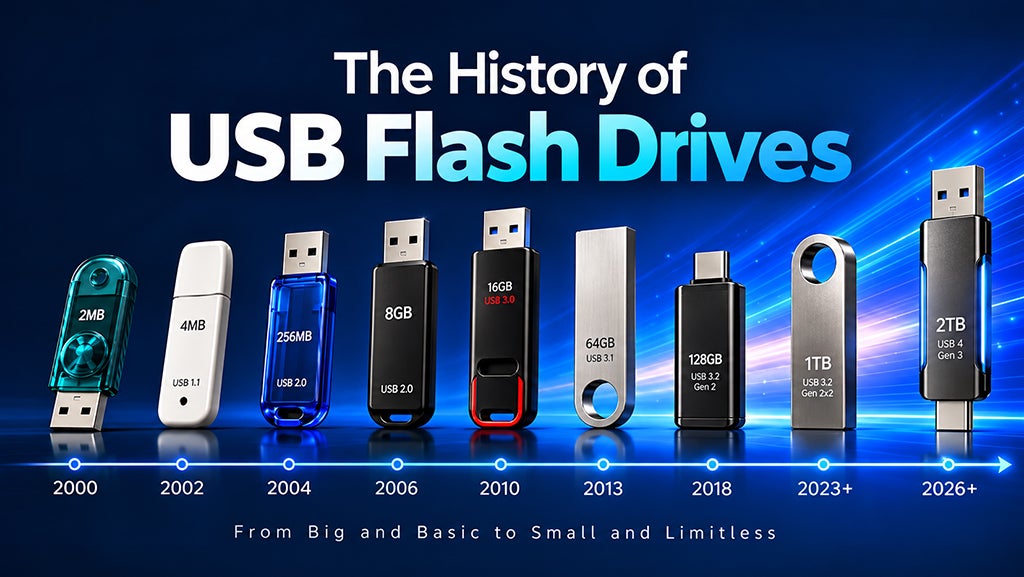
The jump from concept to mainstream happened fast. When thumb drives first appeared in 2000, 8MB was considered impressive - it held more than five times what a floppy disk could. Within a few years, the trajectory became almost hard to follow.
USB flash drives with 1GB of storage hit the market in 2004. By 2010, 128GB models had arrived. Kingston Technology released the first 1TB flash drive in 2013, followed by a 2TB version in 2017. As of 2024, 4TB drives are in production - a 500,000x increase in capacity over the original 8MB device.
Data transfer rates kept pace with storage growth. USB 2.0 made flash drives genuinely fast for everyday use. USB 3.0, introduced in 2008, pushed transfer speeds to 4.8 Gbps - nearly ten times faster again. The latest USB-C connectors brought even higher speeds alongside a reversible, universal form factor that works across mobile devices, laptops, and modern workstations.
The design of flash drives evolved as well. Early models were blocky and functional. Mid-2000s versions introduced the swivel cap, the retractable connector, and the ultra-slim profile. Eventually, manufacturers began producing drives in custom shapes - animals, food items, miniature logos - which made them practical for corporate gifting and branded merchandise, a use case that has proven remarkably durable.
USB Flash Drives Today and Their Role in Business
Despite the rise of cloud storage and network file sharing, USB flash drives remain widely used. They don't require an internet connection. They're fast for large local file transfers. They work across virtually every operating system. And they remain one of the most physically portable ways to carry sensitive data when security or connectivity is a concern.
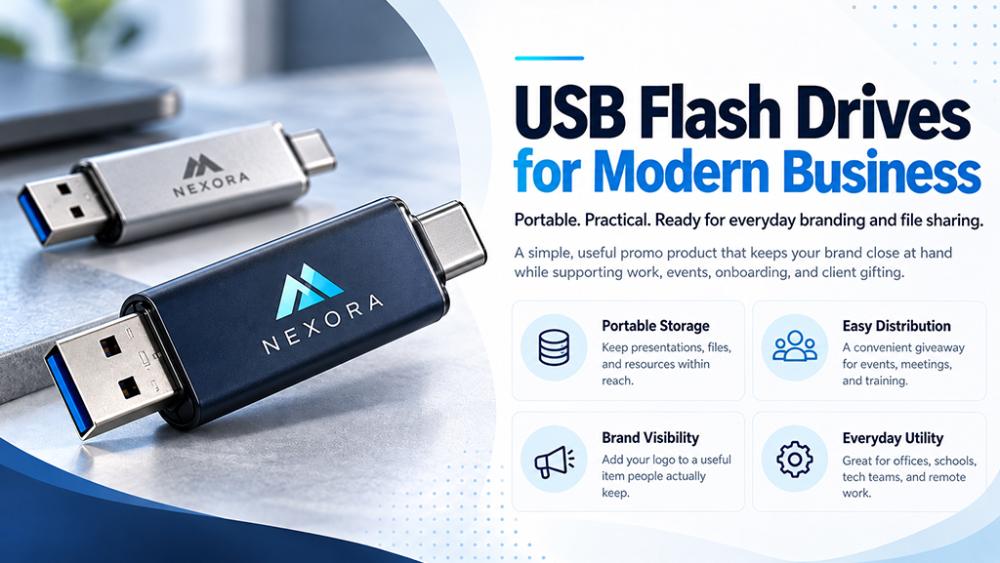
For businesses, custom USB flash drives serve a dual function: practical storage tool and branded promotional item. As Britannica notes, companies had flash drives made with their logos on them early on as promotional tools - a practice that has only expanded. A well-designed branded flash drive is the kind of corporate giveaway that gets used repeatedly, keeping a company's logo in circulation long after the event or campaign that introduced it.
The devices have also become standard in sectors like healthcare, education, government, and live events, where reliable offline data storage is still preferred over cloud-based alternatives.
Get Custom Flash Drives with Logotech
If you're looking for custom USB flash drives for your team, clients, or next event, Logotech offers a wide selection of branded options - from classic designs to fully custom shapes. Whether you need drives for a trade show giveaway, a product launch, or employee recognition, we can help you find the right fit for your program and timeline. Our team works with all order sizes and can guide you through imprint options, storage capacities, and delivery.
Frequently Asked Questions
Q: When was the USB flash drive invented?
A: The first USB flash drive patents were filed in 1999, and the first commercial devices went on sale in 2000. M-Systems (Israel), Trek 2000 (Singapore), and Netac (China) all filed competing claims around the same period, making 1999–2000 the definitive window of invention.
Q: Who invented the USB flash drive?
A: Multiple inventors claim credit. M-Systems' Dov Moran, Amir Ban, and Oron Ogdan filed the first widely recognized patent in April 1999. Trek 2000 was the first company to sell a USB flash drive commercially. IBM engineer Shimon Shmueli also submitted an invention disclosure in 1999. The question of a single inventor remains contested.
Q: What was the storage capacity of the first USB flash drive?
A: The first commercially sold USB flash drives held 8MB of data. By 2024, the largest drives in production hold 4TB - roughly 500,000 times more storage than the original device.
Q: What is the difference between USB 2.0 and USB 3.0?
A: USB 2.0 introduced a maximum transfer speed of 480 Mbps when it launched in 2000. USB 3.0, introduced in 2008, raised that ceiling to 4.8 Gbps and is backward compatible with USB 2.0 devices and ports.
Q: Are USB flash drives still relevant with cloud storage available?
A: Yes. USB flash drives remain useful for large file transfers without internet dependency, secure transport of sensitive data, use in environments with restricted connectivity, and as branded corporate gifts that serve a practical function long after they're received.
Q: What does USB stand for?
A: USB stands for Universal Serial Bus - a standardized connection protocol developed in the mid-1990s by a consortium of technology companies including Intel, Microsoft, and Apple to simplify how devices connect to computers.