


2026-2027 Promotional Events Calendar: Key Dates & Marketing Planner | by Logotech
Most marketing calendars end up as either a wall of dates nobody references again or a spreadsheet that gets built in January and forgotten by March. A promotional events calendar only earns its place if it's actually usable, which means scoping it before you fill it in. Decide how far out you're planning (this guide covers September 2026 through August 2027), who it's built for (marketing team, sales, or the whole company), and whether you need to account for regional holidays if you sell across multiple markets. Set an update cadence too, whether that's a quarterly review or a standing monthly check-in, so the calendar doesn't quietly go stale the way most of them do.

Filter Your Marketing Calendar
A calendar that lists everything at once is hard to act on. Filtering by channel lets your email team, social team, and paid media team each pull the dates that matter to them without wading through the rest. Filtering by region matters just as much if you serve customers outside the US, since a calendar built entirely around American retail holidays will miss real opportunities elsewhere. Filtering by campaign type, discount sales versus new product launches versus loyalty activations, gives you a clearer read on how balanced your year actually is instead of realizing in November that you've run six discount promotions and zero brand-awareness campaigns.
Use Your Marketing Calendar to Plan Marketing Efforts
A calendar view only helps if campaigns are actually mapped to it. For each date worth planning around, assign a campaign owner and a deadline, and link the relevant creative assets, copy docs, or product pages directly to that calendar entry. This is the difference between a calendar that's a reference document and one that's an operational tool. When a date is a week out and nothing's attached to it, that's your signal something got missed, not something you find out after the fact.
Core Elements of Promotional Calendars and Important Dates
A solid promotional calendar mixes three kinds of dates. National holidays and major retail events, like New Year's Day, Valentine's Day, and Black Friday, are the backbone since customer purchasing behavior shifts around them predictably. Awareness months give you a way to align your brand with values your audience cares about, whether that's Earth Day, Pride Month, or an awareness month specific to your industry. And windows reserved for new product launches matter just as much, even though they're not fixed dates on anyone else's calendar. Blocking that time in advance keeps a launch from colliding with an already-busy promotional period.
Month-by-Month Calendar Highlights
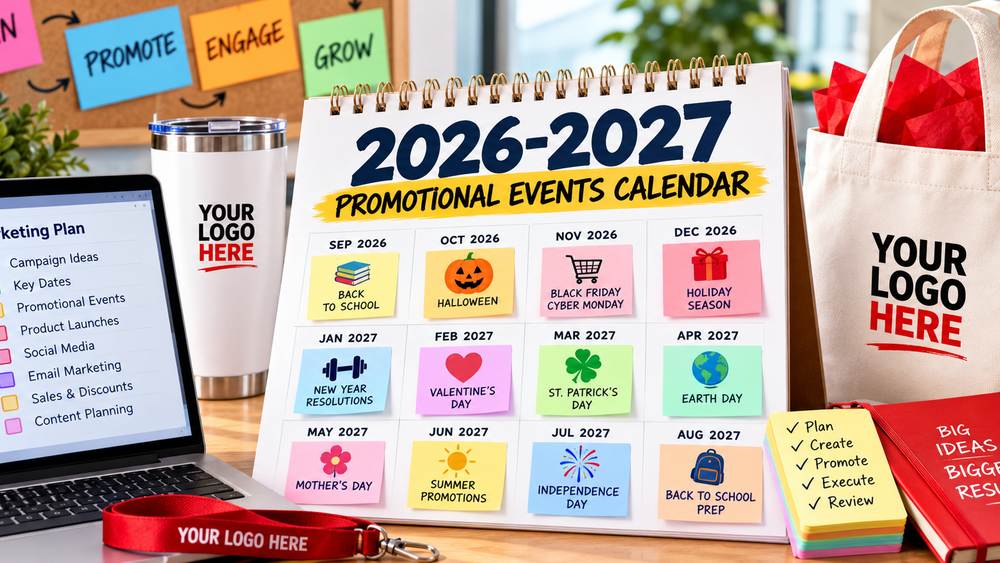
September 2026: Back-to-School and Q4 Prep
Back-to-school campaigns run through most of September, and it's also the month to start Q4 creative and asset production so you're not scrambling in October. Cart-abandonment recovery campaigns tend to perform well here too, since back-to-school shopping generates a lot of browsing that doesn't convert on the first visit.
October 2026: Halloween and Q4 Ramp-Up
Halloween-themed promotions are the obvious play, but October is really about locking your Q4 calendar. Finalize your holiday campaign dates and get seasonal creative and assets approved now, since production timelines only get tighter as November approaches.
November 2026: Black Friday and Cyber Monday
This is the month most B2C brands build their whole quarter around. Schedule Black Friday deals and assets, plan a Cyber Monday email sequence, and don't skip Small Business Saturday if community positioning matters to your brand.
December 2026: Holiday Season and Year-End
Run your final holiday sales and promos, then shift tone for year-end thank-you communications once the shopping rush settles. Close the month with a review of what worked and what didn't. Those notes are worth more in January than they feel like in December.
January 2027: New Year's Day and Winter Promotions
New Year's resolutions drive a predictable wave of interest, so resolution-themed campaigns tend to land well here. Schedule a post-holiday reengagement email for customers who went quiet in December, since a lot of them are still checking their inbox even if they didn't buy anything over the holidays.
February 2027: Valentine's Day and Awareness Months
Valentine's Day on February 14 matters across gifting categories well beyond the obvious ones. February also includes Black History Month, worth spotlighting with real content rather than a one-off post, and Super Bowl messaging if that's relevant to your audience.
March 2027: Women's History Month and St. Patrick's Day
March pairs Women's History Month storytelling with St. Patrick's Day promotions, two very different tones in the same month. If Ramadan falls within your planning window, build in sensitive scheduling around messaging and send times.
April 2027: Earth Day and Easter
Earth Day on April 22 is the natural anchor for sustainability campaigns, and it pairs well with eco-friendly product lines if you carry them. Easter offers a separate seasonal promotion window, and April Fools' Day is worth testing a playful creative if that fits your brand's voice.
May 2027: Mother's Day and Social Moments
Mother's Day gift guides are worth building out well ahead of the date rather than the week before. May also has smaller social moments, like Star Wars Day, that can round out a lighter content calendar without requiring a full campaign build.
June 2027: Pride Month and Summer Kickoff
Pride Month campaigns should be planned early enough to feel intentional rather than reactive. Father's Day sits in the same month, and June generally marks a good point to launch mid-year promotions to boost sales before the summer slowdown sets in.
July 2027: Midyear Promotions and Major Sports Events
Summer clearance sales make sense here, and any major sports events on the calendar, including buildup around the 2026 FIFA World Cup cycle, are worth tying into content if your audience follows the sport. Independence Day campaigns round out the month for US-focused brands.
August 2027: Back-to-Routine and Segmentation
August is a good time to segment lapsed customers for reengagement before the Q4 push begins. End-of-summer offers and early back-to-school promotions both belong here, giving you a soft ramp into September rather than a cold start.
New Product Launch Planning
A launch deserves its own timeline layered on top of the seasonal calendar, not squeezed into whatever week happens to be open. Define your launch milestones and work backward from the date, build in a prelaunch teaser campaign so the launch isn't the first anyone hears of it, and coordinate with whoever handles inventory and fulfillment so demand and supply are actually in sync. Set clear launch KPIs before the date arrives, not after, so you know what success looks like going in rather than deciding after the fact.
Types of Promotions to Schedule
Not every month needs a discount. Discount sales work best with a clear objective behind them, whether that's clearing inventory or driving a specific SKU. New product launches deserve their own strategic window rather than getting bolted onto an existing sale. Holiday-themed campaigns carry seasonal relevance almost automatically. Loyalty program activations reward existing customers instead of only chasing new ones, and UGC contests or referral incentives put some of the promotional work in your audience's hands instead of entirely on your team.
Use Tools to Organize Your Marketing Calendar
A shared calendar that every relevant team can see beats a document that lives in one person's inbox. Integrating it with whatever project management tool your team already uses keeps task tracking attached to the campaign instead of living somewhere separate. Automate publishing wherever the tool allows it, and set reminders ahead of asset approval deadlines specifically, since approvals are almost always where a campaign timeline actually slips.
Measuring and Optimizing Marketing Efforts
Define KPIs for each campaign before it launches, not as an afterthought once the numbers come in. Track channel performance weekly rather than waiting for a monthly rollup, since a weak campaign is much easier to adjust mid-flight than to explain after it's over. Email consistently delivers strong returns on that front, with studies putting email marketing ROI somewhere around $35 to $40 for every dollar spent, which makes it worth the extra attention when you're deciding where to focus optimization time. A/B test creatives and subject lines regularly, and build a monthly review into the process so lessons from one campaign actually inform the next one instead of getting lost.
Celebrate Awareness Months and Employee Appreciation
Awareness months aren't just external marketing opportunities. Scheduling them into your calendar alongside employee appreciation weeks keeps internal culture and external messaging moving in the same direction. Ordering promotional items ahead of time for awareness campaigns, rather than scrambling once the month arrives, gives you room to actually plan a message instead of just slapping a logo on whatever's in stock.
Common Challenges and How to Overcome Them
Dates shift. Vendors change delivery timelines. A campaign that made sense in March can look tone-deaf by the time it launches in a different climate entirely. Build contingency plans for date changes into your calendar from the start rather than treating a shift as a crisis when it happens. Set approval SLAs so a campaign doesn't stall waiting on a single signature, and keep enough flexibility in the calendar to jump on a last-minute opportunity, a trending moment or a competitor's misstep, without blowing up the rest of your plan.

Quick Checklist of Important Dates
A few dates are worth flagging as non-negotiable planning priorities: New Year's Day, St. Patrick's Day in March, Earth Day in April, and Black Friday and Cyber Monday in November. Beyond the fixed calendar, keep new product launch windows marked across every quarter so a big internal milestone never quietly collides with a major shopping date.
Get Custom Products for Every Date on Your Calendar!
A promotional calendar is only half the plan. The other half is having the right branded products ready when each date arrives, instead of placing a rush order the week a campaign is supposed to launch. At Logotech, we help businesses plan ahead for the full calendar, from awareness month giveaways to holiday gifting to launch-day swag. Reach out to your account manager and let's build a product plan that matches your marketing calendar for the year ahead.
Frequently Asked Questions
Q: How far in advance should I build my promotional calendar?
A: Most teams plan a full year ahead, though ordering promotional products for any specific date works best with at least four to six weeks of lead time.
Q: What's the difference between a marketing calendar and a promotional calendar?
A: A marketing calendar covers all campaign activity across the year, while a promotional calendar is typically the retail and sales-focused subset built around specific shopping dates.
Q: Do I need to track awareness months if my business isn't consumer-facing?
A: It's still worth it. Awareness months work well for employee engagement and B2B relationship building even without a retail angle.